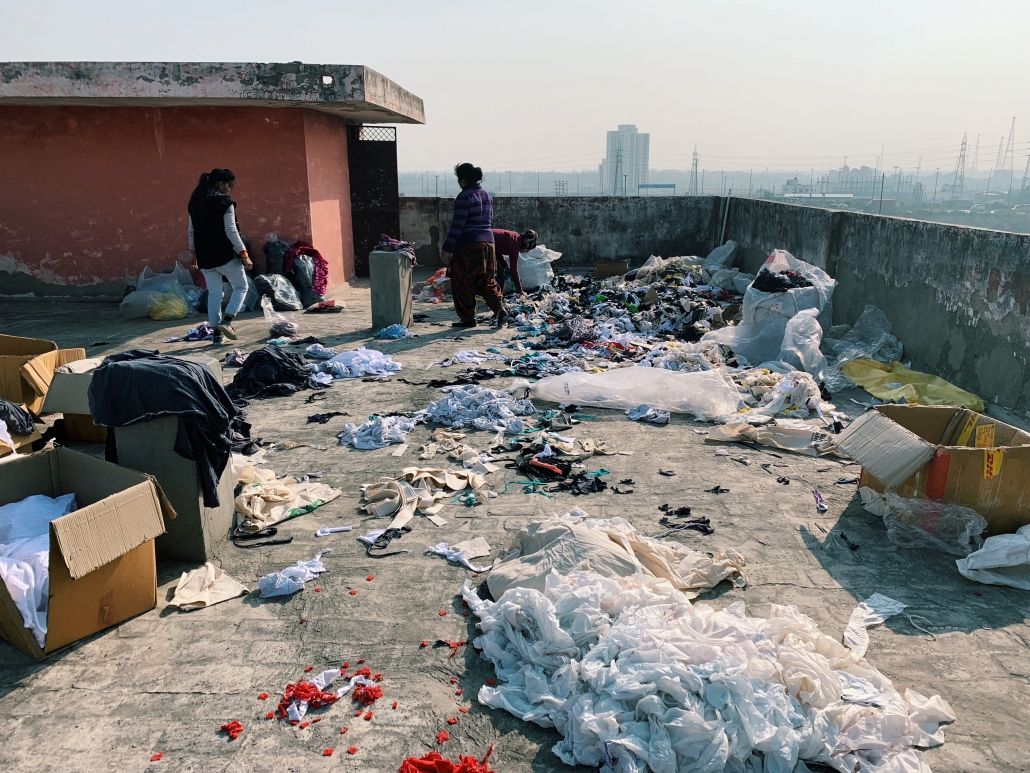
In the world of textile manufacturing, fabric scraps are often treated as an inevitable nuisance. When you cut a curved sleeve or a rounded neckline out of a rectangular sheet of organic cotton, you’re left with “off-cuts” which are small, oddly shaped remnants that most factories simply discard.
Current industry data shows that production waste typically falls between 10% to 30% of intake materials. For many manufacturers, the easiest path is to send those scraps to a landfill. But at WORK+SHELTER, our “triple bottom line” includes people and planet alongside profit. We don’t just see waste; we see raw material for something better.
Here is how we’re giving our off-cuts a second life at our production facility:
1. Hand-Woven Scrap Rugs
We don’t let length go to waste. Longer strips are collected and given to local weavers who transform them into beautiful, durable rugs. For smaller pieces, we save them for “power-down” creative sessions. Since electricity in India can be inconsistent, our team uses downtime to hand-braid and sew these scraps into small rugs. It’s a rhythmic, creative process that keeps our team engaged and our waste bins empty.
2. For Use in Our Paid Training Program
Every new member of the WORK+SHELTER team enters a paid training program to master cutting, stitching, and finishing. Practice makes perfect, but it shouldn’t require virgin fabric. We use our fabric scraps as “practice canvases,” allowing new makers to hone their skills on test products without the environmental footprint of new material.
3. Upcycled Clothing for the Community
As our makers-in-training progress, they move on to small-scale projects like children’s clothing. Because the dimensions are smaller, these items are the perfect use-case for our high-quality organic scraps. Once finished, these garments are donated to local non-profits and orphanages, turning “waste” into warmth for children in the community.
4. Design Partnerships & Education
We believe in the power of collaborative problem-solving. We’ve previously partnered with institutions like the Parsons School of Design in NYC, sending our factory scraps to students to inspire new ways of thinking about circularity. Seeing the next generation of designers turn our remnants into innovative products keeps us inspired to push our own boundaries.
Want to design with scraps?
We love incorporating upcycled elements into custom orders, but scrap-based design requires a bit of a different mindset. Because scraps are inconsistent by nature (we might have a mountain of organic canvas one week and recycled polyester the next), we recommend two golden rules:
- Keep it Small: Think high-utility, low-fabric items like scrunchies, petite zip pouches, or eye masks.
- Keep it Simple: Small pieces can be tricky for complex embroidery or printing. Simple, clean designs work best to showcase the material itself.
Whether you’re a designer looking to “design out” waste or a promotional buyer looking for our pre-developed low-impact products, we’re here to help. Our current line is already developed with waste reduction in mind, and we’re always open to new ideas.
Have a vision for your project’s leftovers?
Drop us a line at hello@workshelter.co and let’s make it happen.
Enjoyed this article?
Share it with your network


