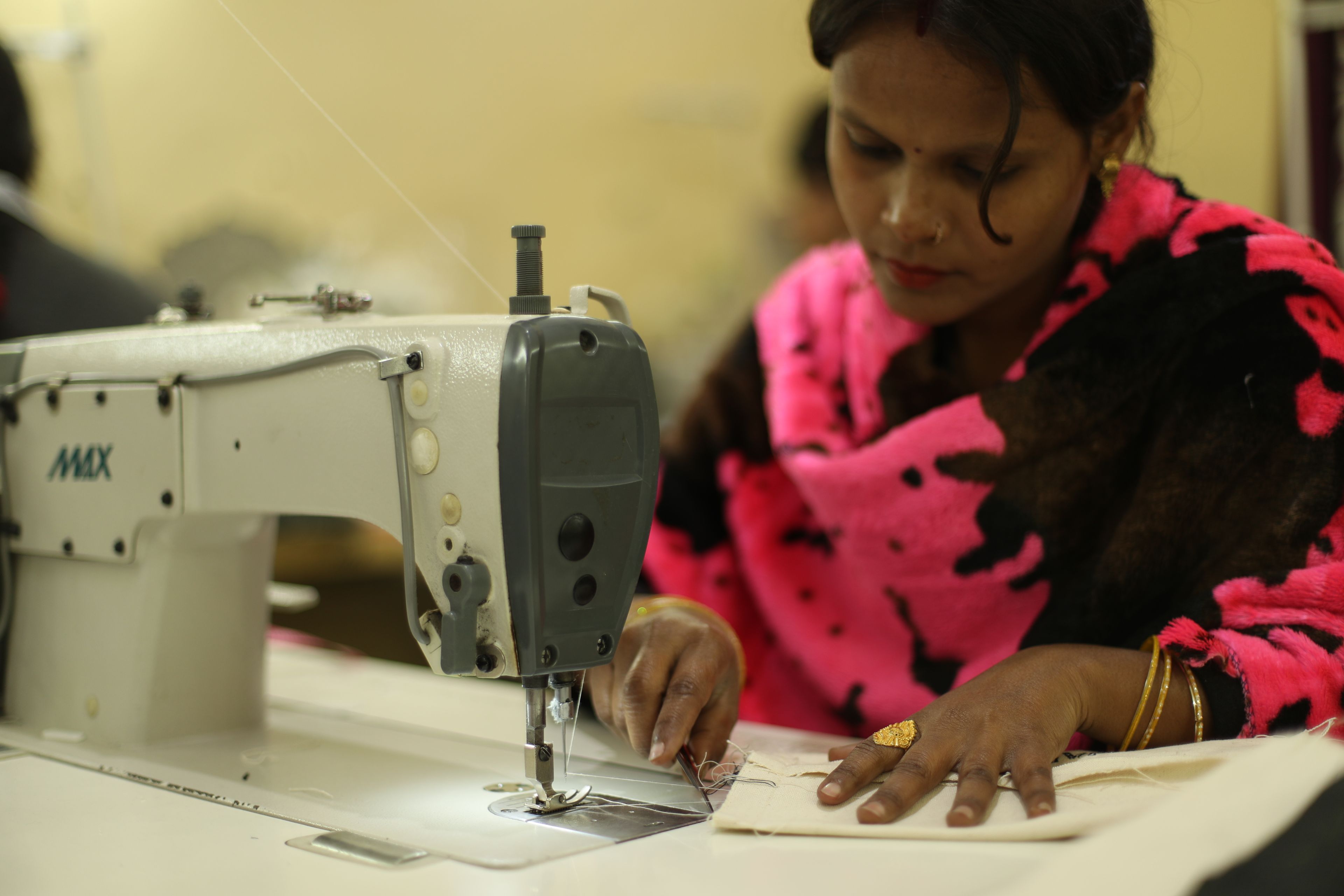
When a factory tells you "we pay our workers fairly," the response that matters isn't "great, thanks" — it's "can you walk me through how?" The answer reveals whether fair means at or above legal minimum (a low bar), at a market rate (normal), or at a living-wage benchmark (what ethical manufacturing actually requires).
Living wage is the compensation a worker needs to cover housing, food, healthcare, transportation, and modest savings for themselves and a small family — without relying on overtime, second jobs, or debt. Minimum wage is whatever the government set, often decades ago and rarely indexed to inflation in a meaningful way. The two are different by factors of 2–3× in most apparel-producing regions.
Here are four questions that separate the factories that pay a living wage from the ones that describe their legal compliance in warmer language.
Question 1 — What is the entry-level operator's total monthly wage, itemized?
Ask for a breakdown, not a total. A compliant answer sounds like:
"An entry-level sewing operator earns a base wage of ₹14,500 per month plus a skill premium of ₹2,000 if certified on multiple machines, plus a performance bonus averaging ₹2,500 monthly. Overtime is paid at 2× base rate and averages ₹1,200 per month. Provident fund (12% employer contribution) and ESI (3.25% employer contribution) are paid on top. Total monthly compensation, before overtime, runs ₹24,300."
A non-compliant answer sounds like:
"We pay well above minimum wage."
The useful signal: can the factory give you a number in the first 30 seconds of the conversation? If not, they're either not tracking it centrally or they'd rather not say. Both are signals.
What the number should be
Benchmark against living-wage data from Asia Floor Wage Alliance (AFWA), Global Living Wage Coalition (GLWC), or the Wage Indicator Foundation for the specific state or region. For India as of 2026:
- Statutory minimum: ₹10,000–₹14,000/month depending on state
- GLWC living-wage benchmark: ₹24,000–₹32,000/month
- AFWA Asia Floor Wage: roughly ₹27,000/month for India
If the factory's total monthly operator compensation (including PF/ESI employer contribution, performance bonus, skill premium) lands in the ₹24,000–₹30,000 range for an entry-level operator, they're paying at or above the living-wage line. Anything substantially below is paying below living wage.
Question 2 — How does the piece-rate structure work?
Most Indian garment factories pay some version of piece rate — more output means more pay. That's not inherently bad; the question is how it's structured.
A healthy piece-rate structure
- Base hourly or daily guarantee regardless of output. Operators don't lose income on machine-down days or slow startup weeks.
- Piece rates calibrated to living wage at reasonable pace. The factory has done the math: an average-skilled operator working at normal pace, not rushing, can earn the living-wage equivalent within standard hours.
- Transparent rate setting. Rates are visible to workers, not adjusted downward when output increases ("rate-busting"), and revised openly when product changes.
- Piece rates on top of a base wage — the base is the floor; piece rate is the upside.
A predatory piece-rate structure
- No base guarantee. Slow day = no pay.
- Rates set so low that an operator has to work overtime or rush unsafely to hit a living wage.
- Rates adjusted downward when average output rises — the "fastest operator sets the new rate" trap.
- Deductions for quality issues that exceed what was earned on the piece.
Ask: "If an operator works a standard 8-hour day at normal pace, what do they earn?" The compliant answer includes a specific ₹ number that lands at or above minimum wage.
Question 3 — How is overtime paid and tracked?
Indian law requires overtime at 2× base wage rate for hours beyond 9 per day or 48 per week. Many factories pay straight time ("1×") despite the legal requirement — or pay 2× on the books but restrict access to overtime in ways that hide underpayment.
What to ask
- "How many hours of overtime did your average operator work last month?"
- "Show me a sample pay stub that includes overtime — I want to see the rate."
- "Do workers have the right to refuse overtime, and what's the process?"
A factory with clean overtime practice runs moderate overtime (4–12 hours per week average), pays 2× on legal terms, and has a documented right-to-refuse that workers can exercise without retaliation.
A factory with practices that should worry you:
- Overtime averaging 20+ hours per week routinely (signal: base wages are too low, workers need OT to make rent)
- Overtime billed to customers at 2× but paid to workers at 1.2× (difference pocketed by management)
- No documented right-to-refuse, or refusal results in workers being moved to lower-paying lines the next week
Question 4 — Can I see a random sample of pay stubs during my visit?
This is the most revealing question, and the one most factories have not been asked.
A factory that says yes, and produces 10 stubs with worker names redacted, matching the wage structure they described in questions 1–3, is almost certainly paying what they claim.
A factory that says yes, and the stubs don't match the claimed structure — base wages lower than stated, overtime at the wrong rate, deductions for reasons that look suspicious — is caught.
A factory that says no, or that says the request is unusual, or that offers to share "management-approved examples" selected by them, is telling you to take their word for it.
Third-party auditors (SA8000, SMETA, GOTS social audits) do exactly this during their visits. You can too. A reputable factory expects this request from audit clients and has a process for it that respects worker privacy (redaction, limited access, chaperoned review).
Why this matters beyond ethics
Wage practices predict turnover, quality, and training investment. A factory paying living wages typically has 10–15% annual turnover vs 30–45% at minimum-wage factories. Lower turnover means more experienced operators means fewer defects means less rework means better margin for you and the factory. The "ethical manufacturing premium" often pays for itself in reduced QC rework and shorter learning curves on new product.
The four questions above are the minimum due-diligence bar. A factory that answers them cleanly is a factory you can partner with for years. A factory that fumbles them is a factory where "living wage" is a marketing phrase.
Frequently asked questions about factory wages
What's the typical gap between minimum and living wage in India?
In 2026, India's statutory minimum wage for garment workers ranges ₹10,000–₹14,000 per month depending on state. Living-wage benchmarks from Asia Floor Wage Alliance and Global Living Wage Coalition for the same states are roughly ₹24,000–₹32,000 per month. That's a 2–3× gap. A factory paying at the statutory minimum is legally compliant but paying roughly a third of what a worker needs to cover food, housing, healthcare, and basic family support independently.
Is piece rate always worse than hourly?
Not inherently. Piece rate pays for output — skilled operators can earn well above hourly equivalents. The problems arise when piece rates are set too low to allow a worker to earn a living wage at reasonable pace, or when piece rate is structured without a base guarantee (so slow days or machine-down days leave workers with no income). Ethical piece-rate structures include a base hourly guarantee regardless of output and piece rates calibrated to living-wage targets for average output.
What does a legal pay stub actually show?
A compliant Indian pay stub itemizes: base wages (month total), piece-rate bonus if applicable, overtime wages (at 2× base rate by law in India), PF/ESI deductions (provident fund and employee state insurance — social security), any advance or loan deductions, and net payable. It should be signed or acknowledged by the worker. A stub that just shows "total: ₹X" with no breakdown is either non-compliant or hiding structural issues the worker can't challenge.
How do I actually see pay stubs during a visit?
Request to see a random sample of 10 worker pay stubs from the previous month during a site visit, with worker names redacted for privacy. A factory that declines is telling you something. A factory that hands them over, and the numbers align with living-wage benchmarks and overtime is being paid at the legal premium, has materially lower risk. Auditors from SA8000, SMETA, and GOTS do exactly this during their visits — you can too if you're on-site.
Related reading
- Inside a Women-Led Factory Floor — what management structures look like when wage fairness is built in.
- SA8000 vs Fair Trade vs BSCI: Which Social Audit Matters — the third-party audit programs that ask these questions professionally.
- What "Ethical Manufacturing" Actually Costs Per Unit (With the Math) — where the wage premium lands in your per-unit cost.
Found this useful?
Share it with your network