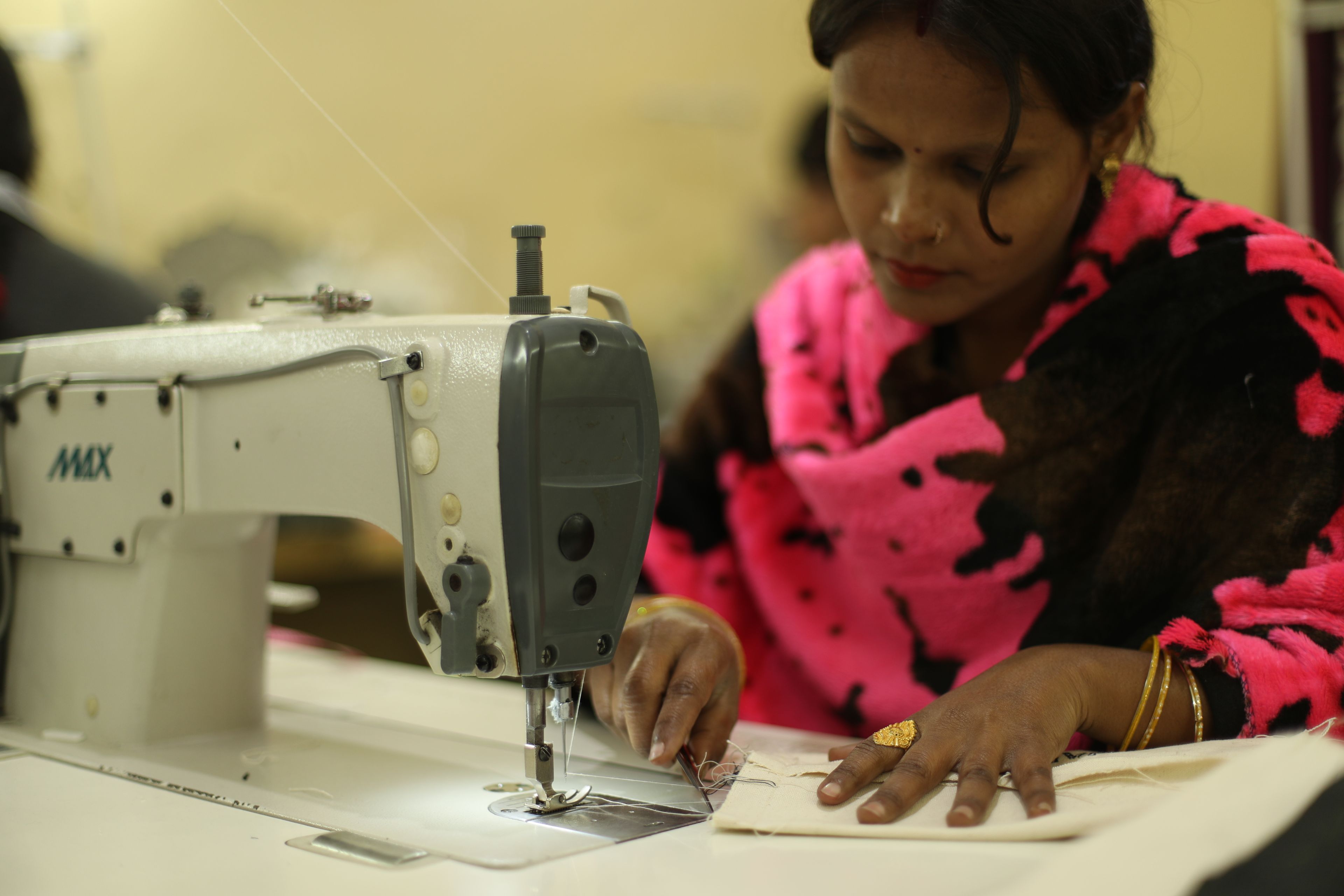
India's apparel industry — roughly $16 billion in exports per year, around 45 million workers across formal and informal employment — is a case study in how a women-dominated workforce ends up largely managed by, and structurally disadvantaged compared to, men. The numbers aren't secret; they're just not usually collected in one place.
This article pulls a few of them together. It's written for brand leads whose customers care about gender equity in supply chains and need something sharper than a generic "women's empowerment" claim.
The workforce composition
- Roughly 60% of workers across India's formal apparel-export sector are women; in Tirupur specifically the share approaches 80%.
- In hand embroidery, cutting-and-finishing, and trim attachment (lower-paid roles), women hold 75-90% of positions.
- In supervisor, line-lead, and management roles, women hold 10-20% of positions.
- Factory ownership and senior management are overwhelmingly male — estimates put female ownership in the apparel-export sector below 5%.
The wage gap
ILO and national labor-bureau data consistently show female garment workers in India earning 15-25% less than male workers in comparable roles, before accounting for role segregation. When role segregation is included (men cluster in higher-paid cutting, pressing, and supervisory work; women cluster in lower-paid stitching and finishing), the effective gap widens further.
Working-hour patterns
Women workers in India's apparel sector report:
- Longer commutes than men on average (2-3 hours round trip is common in Delhi NCR; factory shuttles are a rare amenity)
- Higher rates of unpaid overtime, particularly around order-deadline crunches
- Less flexibility to accommodate caregiving responsibilities — maternity leave compliance is improving but still uneven, and return-to-work support is rare
Safety and grievance infrastructure
Credible industry surveys (the ILO's Better Work program, Sedex audit aggregates, and NGO studies by FWF and Good Weave) find that:
- ~60% of female apparel workers report having witnessed or experienced workplace harassment; reporting rates are far lower
- Only ~35% of factories have a functioning Internal Complaints Committee as required under India's 2013 Sexual Harassment of Women at Workplace (Prevention, Prohibition and Redressal) Act — despite legal requirement
- Childcare provision (mandatory for factories with 30+ women under India's Maternity Benefit Amendment Act, 2017) is present in under half of applicable factories
Where the bright spots are
Factories that have consistently moved these numbers do a few specific things:
- Promote women into supervisor roles, not just stitching
- Provide onsite childcare or subsidized arrangements
- Run transport to reduce commute-related harassment
- Maintain a functioning Internal Complaints Committee with an external member
- Pay transparently with publicly posted wage grids
- Offer skills training that actually leads to promotions (not just compliance theater)
The factories that do most of the above tend to be mid-size (under 500 workers), privately held, and led by founders who've made gender equity an explicit strategic priority rather than a downstream HR concern.
What a brand lead should ask
When evaluating a factory on its impact claims:
- What percentage of supervisors and line leads are women?
- What percentage of workers are women? (Many factories over-index on easier female-coded roles while staying male at the top.)
- Is there an onsite or subsidized childcare arrangement?
- Is there a functioning Internal Complaints Committee? How many cases were filed and resolved in the last year?
- What is the gender-disaggregated wage data for comparable roles?
- What is the gender-disaggregated promotion rate over the last three years?
Factories that can answer with specifics are doing the work. Factories that deflect ("everyone is treated equally") are telling you it's not being measured.
The commercial case
Factories that actively invest in female leadership and equitable practices report lower turnover (5-15% annually vs 30-50% at comparable factories), lower absenteeism, and better quality consistency. These aren't separate from commercial performance — they are commercial performance.
A brand partnering with a rigorously women-equitable factory gets all the story benefits plus the supply-chain reliability that comes with workers who actually stay long enough to master their craft.
A final note on the data
Much of what's above is from published ILO, Sedex, national labor-bureau, and credible NGO sources. Industry-wide numbers move slowly; the ones in this article should hold directionally for several years. Factory-specific numbers are what move the needle — and those are the ones brands should be asking about, not debating in the abstract.
Frequently asked questions about women in India's garment industry
What's the gender pay gap in Indian garment factories?
ILO and national labor bureau data shows female apparel workers in India earn roughly 15-25% less than male workers in comparable roles. When role segregation is included — men cluster in higher-paid cutting, pressing, and supervisory roles — the effective gap widens further. The gap is smallest at audited, export-focused factories and largest in informal subcontracting.
How do I verify a factory's claims about women leadership?
Ask for the gender breakdown at three levels: worker, supervisor/line-lead, and management. Get numbers, not percentages (500/800 is more honest than "60%"). Ask for the last three years' promotions from line to supervisor. A substantive women-led factory can answer in specifics; a marketing-led one will deflect to "we treat everyone equally."
Do women-led factories charge more?
Rarely meaningfully — the per-piece cost premium from investing in gender equity is small compared to the overhead of the factory itself. What costs more is the kind of onsite amenities (childcare, transport, grievance committees) that support the claim. Expect women-led factories to sit at the higher end of their regional cost band, not dramatically above it.
What regulations protect women garment workers in India?
The 2013 Sexual Harassment of Women at Workplace (Prevention, Prohibition and Redressal) Act requires all workplaces with 10+ employees to have an Internal Complaints Committee. The 2017 Maternity Benefit Amendment Act mandates onsite childcare for factories with 30+ women workers. Compliance is uneven — less than half of covered factories fully implement either.
Related reading
- What a Women-Led Factory Floor Actually Changes — how the data above plays out on a real production floor.
- SA8000 vs Fair Trade vs BSCI: Which Social Audit Matters — the audit frameworks that put numbers on these practices.
- Garment Manufacturing in India: A Buyer's Guide — broader context for sourcing in India.
Found this useful?
Share it with your network